The electric car got another nudge—perhaps a significant nudge—towards reality with a new plan from the European Commission to standardize charging points for electric vehicles.
“The new European strategy will provide a supportive framework based on a twin-track approach: improving the efficiency of conventional engines and making ultra low-carbon mobility a reality for European consumers … The strategy also aims at achieving common standards for electrical cars so that they can be charged everywhere in the EU.”
There is a bit of Eurocrat-ese to wade through here, but these two goals from the plan stood out:
-
Promote common standards that will allow all electric vehicles to be charged anywhere in the EU.
-
Encourage installation of publicly accessible charging points.
Sounds like a good start. A report released in conjunction with the plan, goes a little deeper on the two points.
“However, fast charging with high voltage, public charging points and the need to ensure communication between the vehicle and the electricity grid requires a dedicated plug and socket, which needs to be standardized at the EU level to ensure interoperability…An adequate electric charging network will require significant investment and definition of standards on safety, interoperability and payment.”
Think of it as the Euro of electric vehicles. It wasn’t too long ago in Europe that you had to stop at every new border, hit up the ATM and grab some cash. Now, with the Euro you can glide over borders without a second thought.
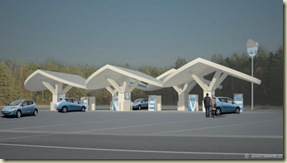
It’s kind of the same thing with pan-European charging stations for electric cars. The idea is to be able to drive any make of electric car from the Scottish highlands to Sicily with the knowledge you can plug it in conveniently anywhere, charge up quickly and be on your way. It’s a compelling vision.
But what will these “zero emission” cars run on ultimately? Sure, you’re getting off oil, but if you’re replacing it with another high-emission fossil fuel you really haven’t made much progress. (Of course, “zero emission” is a bit of a polite fiction as nothing is truly zero emissions over its entire lifecycle.)
In a question and answer piece, the EC notes:
The environmental impact of fully electric vehicles depends largely on the production of electricity that is used to charge them…care will have to be taken that electric vehicles are charged by using electricity from renewable sources to the extent possible...”
In another piece the EC quotes an interesting statistic:
“The global car fleet is predicted to grow from 800 million to 1.6 billion vehicles by 2030. In order to ensure sustainable mobility, a step change in automotive technology must happen.”
Now, that may be a global, not European statistic, and significant market penetration of electric cars may take some time. However, putting all these pieces together, it’s not that big of a leap to the next point: if electric vehicles are going to start gathering market share and if we expect them to be low emissions we will need to make sure the grid is as clean as possible. Renewables? Sure. Efficiency? You bet. Smart Grid? Sounds good. Nuclear? No doubt.
It seems that if Europe wants to realize its dream of “sustainable mobility,” it will have to continue to rely on "the largest source of largely carbon-free energy in Europe,” a source that provides about a third of the EU's electricity: nuclear energy.

The Brokdorf nuclear plant in Germany. Click on the photo, then click the “coordinates” link in the upper right corner. Then, choose the “satellite” version of your favorite map application. You should be able to find wind farms to the north and northwest of the plant.
Comments
Ya now a days electric car demand increasing.