
How Advocacy Helped Repeal Wisconsin’s Nuclear Moratorium

Jon Breed
The following guest post is from Jon Breed, manager of state and federal advocacy at NEI.

On April 1st, 2016, Governor Scott Walker signed a bipartisan bill ending Wisconsin’s 33-year moratorium against building new nuclear energy facilities. After signing the bill, Walker said that “nuclear energy sustains Wisconsin’s economy two ways, both in employing a skilled, well-paid workforce to run a nuclear plant, and in providing the affordable, reliable source of emission-neutral power on which all businesses and employers rely.”

The passage of the bill is a testament to the power of coalitions and grassroots advocacy and will serve as a model for how pro-nuclear advocates drive policy outcomes in the future.

A lot has changed in American politics in the past fifteen years. The age of shoe-leather lobbying has been supplemented by a new kind political influence: the power of coalition advocacy. This shift began with the rise of the internet and was refined by groups like Organizing for America and Heritage Action.

Understanding this change in political winds, NEI saw an opportunity to activate nuclear energy advocates when Wisconsin State Representative Kevin Petersen introduced a bill to repeal his state’s nuclear energy ban last October. This set off a chain of events that ultimately led to the bill’s passage.
Before getting involved, however, we asked ourselves three very basic questions:

  • Does it advance NEI’s policy priorities?
  • Is there a path to success?
  • Who are our allies on the ground and how do we get them engaged?

The first question was easy. The initial ban on new nuclear energy was put into place in the 1980s and NEI has worked for years to repeal the moratorium.

Next we looked for a path to success. Our initial analysis revealed a state political system that was deeply divided. Despite the fact Wisconsin has a Republican Governor and Republican-controlled legislature, the volatile political landscape has created bitter partisan divide.

However, the industry views nuclear energy as a bipartisan issue capable of bringing people together. As a result, we set out to build a coalition of Wisconsin advocates dedicated to communicating nuclear energy’s value proposition.

In October, NEI’s State Outreach and Advocacy Team came together to formulate a deliberate and comprehensive plan that would best leverage the power of grassroots advocacy. After taking an inventory of potential allies, we executed a broad outreach initiative that included local politicians, policymakers, unions, business coalitions, student groups, academics, small businesses, environmentalists and electric industry experts. What resulted was a sizable coalition that effectively engaged both sides of the aisle.

Despite this precarious political landscape, the strategy worked. After countless phone calls, emails, letters, social media engagements and office visits, we saw an issue, that has historically failed, gain real traction.

So much traction, in fact, that the Wisconsin Assembly passed the bill unanimously and the Wisconsin Senate passed it with a large bipartisan majority: 23-9. Shortly thereafter, Governor Walker signed the bill into law before a large audience of nuclear advocates at the University of Wisconsin.
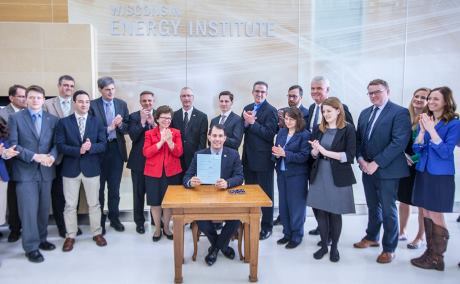
Signed, sealed and delivered.
As NEI continues to explore the future of advocacy, we will study this victory. What a coalition of nuclear advocates accomplished in Wisconsin in just six months demonstrates the power of grassroots activity and underscores just how much the American political landscape has shifted. As NEI moves forward – there are 12 more states with moratoriums on nuclear energy – we will continue to develop our strategies , and work hard to keep pace with the ever-changing nature of politics.

Comments

Popular posts from this blog

Activists' Claims Distort Facts about Advanced Reactor Design

Below is from our rapid response team . Yesterday, regional anti-nuclear organizations asked federal nuclear energy regulators to launch an investigation into what it claims are “newly identified flaws” in Westinghouse’s advanced reactor design, the AP1000. During a teleconference releasing a report on the subject, participants urged the Nuclear Regulatory Commission to suspend license reviews of proposed AP1000 reactors. In its news release, even the groups making these allegations provide conflicting information on its findings. In one instance, the groups cite “dozens of corrosion holes” at reactor vessels and in another says that eight holes have been documented. In all cases, there is another containment mechanism that would provide a barrier to radiation release. Below, we examine why these claims are unwarranted and why the AP1000 design certification process should continue as designated by the NRC. Myth: In the AP1000 reactor design, the gap between the shield bu...

How many nuclear plants does it take to meet the world's energy needs?

Several weeks ago Joshua Pearce at Clarion University in Pennsylvania released a study titled “ Thermodynamic limitations to nuclear energy deployment as a greenhouse gas mitigation technology .” In the study he stated... nuclear energy production would have to increase by 10.5% per year from 2010 to 2050 to both replace fossil-fuel-energy use and meet the future energy demands. This line, of course, made the headlines and has been picked up by several outlets and blogs . When looking into his calculations for this statement, he made one assumption error that overstated the above sentence by nearly a factor of three. Page 121, Section 4.1 of the study states: Richard Smalley pointed out that in 2004, the global economy consumed the equivalent of 220 million barrels of oil per day, which converted into electricity terms is the equivalent of 14.5 TeraWatts (TW), or 14,500,000 MegaWatts (MW) (2005). … With a nuclear plant having about 1000 MW (1 GW) of capacity, we would need 14,500...

What Happens During a Refueling Outage?

You may have noticed over the past few weeks that a number of nuclear plants are shut down for refueling outages or are resuming operations after just returning from one. This type of routine outage usually occurs in the spring or fall when electricity demand is low so that nuclear reactors can replace about one-third of the spent fuel rods with new fuel and conduct other routine maintenance and repairs at the plant. To get a better sense of how refueling works at a nuclear energy facility, I spoke with Marcus Nichol, NEI’s senior project manager for used fuel storage and transportation, and asked him to explain the basics. Why does a nuclear plant need to replace one-third of its fuel? Nichol: The main purpose of a refueling outage is to replace older fuel that is depleted—meaning it can no longer efficiently produce energy from nuclear fission reactions—with new fuel. This “used fuel” has typically been used in the reactor for four-and-a-half to six years before it is pe...