
Ralph Nader at NEI - the Wrapup

Ralph Nader and some Greenpeace activists showed up yesterday outside our offices to shout slogans and wave signs - well, not Nader himself, but his crew. As you may know, Washington is the go-to stop on Amtrak when you have a sign and a slogan, so the lunchtime crowd is very used to this happening pretty much every day. In our view, Nader and crew should have promoted his appearance a little better, perhaps on D.C.'s numerous college campuses. As is, the whole thing seemed a bit ad hoc.

But it would be churlish of us not to include some photos. These were taken by NEI's staff photog, Anna Gomez.
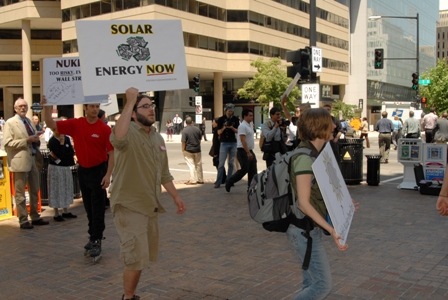
protest

This was directly in front of NEI's building - the front door faces a corner - and is what was going on before Mr. Nader arrived. This looks like a pretty thin crowd, but deceptively so - about 35 or so people aside from NEI employees turned out and some lunchtimers stopped for a moment or two to listen.
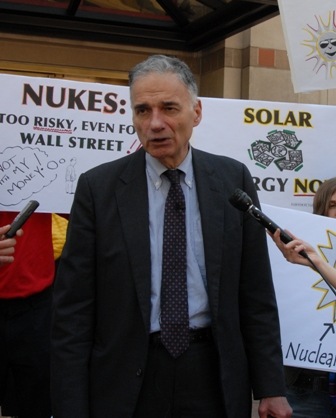
nader1

Here's Mr. Nader. The microphones poking at him are from various energy news outlets, like Platts. We didn't notice major press figures, though of course they might have been there. Note "Nukes" on the sign - a little whiff of eighties nostalgia. Happily, there were no headbands or day-glo pants on view.

Mr. Nader was a little taller than I expected, a bit slouchy and a bit hangdog. He has a strong, distinctive voice, but directed his comments mostly at those microphones rather than the gathered throng. He did deliver a bit of what seemed his stump speech on energy issues - you can get a sense of that at his web site - but was a fairly modest presence for a presidential candidate. I think we can assume he wants to promote issues that matter to him rather than have to pick an Agriculture Secretary, so the small audience and pack of interested newshounds seem about right.

Well, a little excitement on a Thursday - everyone was quite gracious, the tone remained friendly and inclusive rather than combative, and the Greenpeace folks looking to snare donations were as chirpy and animated as can be. It was a treat for many here to shake hands with Mr. Nader and express respect for what his life has been and continues to be: substantial, unique and very American.

The only outside link to this event I've found is to Crosswalk, a Christian outlet. If you find others, add them in the comments.

Comments

Anonymous said…
Seems like you all have a huge crush on Ralph. Frankly, I don't see it. Seeking publicity and mouthing off to the press is one thing, coming up with practical, workable solutions to the energy problem is another. I'll save my respect for those who go out everyday and do their work, in the field, in the power plants, in the laboratories, who are working on ways to generate the energy we need. Those who seek to tear down those efforts can take a hike.

Popular posts from this blog

Activists' Claims Distort Facts about Advanced Reactor Design

Below is from our rapid response team . Yesterday, regional anti-nuclear organizations asked federal nuclear energy regulators to launch an investigation into what it claims are “newly identified flaws” in Westinghouse’s advanced reactor design, the AP1000. During a teleconference releasing a report on the subject, participants urged the Nuclear Regulatory Commission to suspend license reviews of proposed AP1000 reactors. In its news release, even the groups making these allegations provide conflicting information on its findings. In one instance, the groups cite “dozens of corrosion holes” at reactor vessels and in another says that eight holes have been documented. In all cases, there is another containment mechanism that would provide a barrier to radiation release. Below, we examine why these claims are unwarranted and why the AP1000 design certification process should continue as designated by the NRC. Myth: In the AP1000 reactor design, the gap between the shield bu...

How many nuclear plants does it take to meet the world's energy needs?

Several weeks ago Joshua Pearce at Clarion University in Pennsylvania released a study titled “ Thermodynamic limitations to nuclear energy deployment as a greenhouse gas mitigation technology .” In the study he stated... nuclear energy production would have to increase by 10.5% per year from 2010 to 2050 to both replace fossil-fuel-energy use and meet the future energy demands. This line, of course, made the headlines and has been picked up by several outlets and blogs . When looking into his calculations for this statement, he made one assumption error that overstated the above sentence by nearly a factor of three. Page 121, Section 4.1 of the study states: Richard Smalley pointed out that in 2004, the global economy consumed the equivalent of 220 million barrels of oil per day, which converted into electricity terms is the equivalent of 14.5 TeraWatts (TW), or 14,500,000 MegaWatts (MW) (2005). … With a nuclear plant having about 1000 MW (1 GW) of capacity, we would need 14,500...

What Happens During a Refueling Outage?

You may have noticed over the past few weeks that a number of nuclear plants are shut down for refueling outages or are resuming operations after just returning from one. This type of routine outage usually occurs in the spring or fall when electricity demand is low so that nuclear reactors can replace about one-third of the spent fuel rods with new fuel and conduct other routine maintenance and repairs at the plant. To get a better sense of how refueling works at a nuclear energy facility, I spoke with Marcus Nichol, NEI’s senior project manager for used fuel storage and transportation, and asked him to explain the basics. Why does a nuclear plant need to replace one-third of its fuel? Nichol: The main purpose of a refueling outage is to replace older fuel that is depleted—meaning it can no longer efficiently produce energy from nuclear fission reactions—with new fuel. This “used fuel” has typically been used in the reactor for four-and-a-half to six years before it is pe...