
EPA’s Clean Power Plan Needs Nuclear Energy On The Menu

Matt Wald
The following is a guest post from Matt Wald, senior director of policy analysis and strategic planning at NEI.

It’s so obvious that it shouldn’t bear repeating, but it does: If you’re worried about climate change, one early, easy remedy is to preserve nuclear power plants that are already running. If you are facing limits on carbon emissions, don’t shut down perfectly serviceable merchant nuclear plants, just because cheap natural gas has left them, for now, a few bucks out of the money in the competitive electricity markets.

Last Thursday the National Association of Clean Air Agencies, a group made up of officials from 42 states and the District of Columbia, plus 116 metropolitan areas, released its 465-page “Menu of Options” for complying with the Environmental Protection Agency’s Clean Power Plan (Section 111 (d) of the Clean Air Act).

We could quibble with some details, like describing nuclear technology as “mature.” It is highly developed, but it has evolved markedly in the last 20 years, and that will continue. Don’t discount the idea of new designs and fresh reactor concepts that will change the energy world in the 2020s or 2030s.

We could also argue with the report’s characterization of nuclear power as not renewable; when circumstances favor it, the world will build plants that make more fuel than they consume, and can go back to pull energy resources out of spent fuel.

But the menu makes two very clear points. First, drawing on a finding of the EPA, it concludes, “preserving the availability of existing units that might otherwise be retired is a cost-effective way to reduce GHG emissions.” (In fact, taking a reactor out of the mix now is a bit like trying to pilot a ship through a storm, deciding that it will be necessary to bail, and instead of pumping water out of the bilge, pumping it in.)
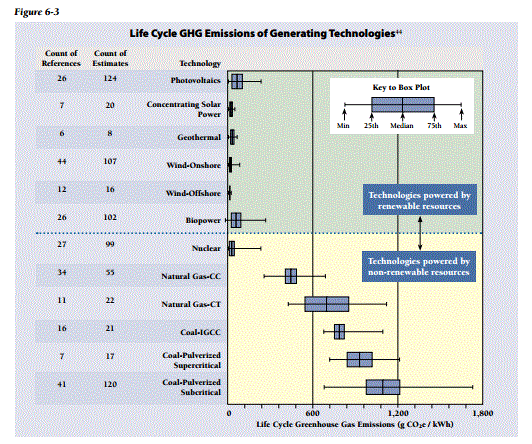
Nuclear energy. Down in the weeds, but in a sweet spot.
And second, “zero emissions” are never precisely zero, but they get pretty close. The study lists a cradle-to-grave, “lifecycle” estimate of emissions, including construction, fabrication, fuel processing, etc, for twelve technologies, based in hundreds of separate studies. The handbook gives an upper and lower bound. Nuclear is, to use the technical term, down in the weeds, lower than biopower and photovoltaics, in the ballpark with geothermal, and a smidgen above wind. Combined cycle natural gas, which rules the market for the time being – as long as carbon emissions are completely free, and emissions of other air pollutants are not counted in dollar terms – are about ten times higher; coal, depending on the technology, is twelve to fifteen times higher.

The handbook also compares “levelized costs,” (see below) that is, costs that take into account fuel, construction expense, and the lifetime of the asset. These, too, are expressed in a range. For the central estimate, new nuclear is, in fact, pricey, but not nearly as expensive as the two forms of solar – photovoltaic cells, or thermal systems, which use the sun’s heat to boil water.
Priced more competitively than you might think.
Energy from wind can be slightly cheaper, but you don’t get to pick when the wind blows.

Comments

jim said…
Re: "...preserving the availability of existing units that might otherwise be retired is a cost-effective way to reduce GHG emissions.”

Start with Vermont Yankee for one, EPA.

Sadly, talk is cheap. VERY cheap. Even in matters of global environmental emergencies.

James Greenidge
Queens NY

Popular posts from this blog

Activists' Claims Distort Facts about Advanced Reactor Design

Below is from our rapid response team . Yesterday, regional anti-nuclear organizations asked federal nuclear energy regulators to launch an investigation into what it claims are “newly identified flaws” in Westinghouse’s advanced reactor design, the AP1000. During a teleconference releasing a report on the subject, participants urged the Nuclear Regulatory Commission to suspend license reviews of proposed AP1000 reactors. In its news release, even the groups making these allegations provide conflicting information on its findings. In one instance, the groups cite “dozens of corrosion holes” at reactor vessels and in another says that eight holes have been documented. In all cases, there is another containment mechanism that would provide a barrier to radiation release. Below, we examine why these claims are unwarranted and why the AP1000 design certification process should continue as designated by the NRC. Myth: In the AP1000 reactor design, the gap between the shield bu...

What Happens During a Refueling Outage?

You may have noticed over the past few weeks that a number of nuclear plants are shut down for refueling outages or are resuming operations after just returning from one. This type of routine outage usually occurs in the spring or fall when electricity demand is low so that nuclear reactors can replace about one-third of the spent fuel rods with new fuel and conduct other routine maintenance and repairs at the plant. To get a better sense of how refueling works at a nuclear energy facility, I spoke with Marcus Nichol, NEI’s senior project manager for used fuel storage and transportation, and asked him to explain the basics. Why does a nuclear plant need to replace one-third of its fuel? Nichol: The main purpose of a refueling outage is to replace older fuel that is depleted—meaning it can no longer efficiently produce energy from nuclear fission reactions—with new fuel. This “used fuel” has typically been used in the reactor for four-and-a-half to six years before it is pe...

How Much Land Does Nuclear, Wind and Solar Really Need?

Not too long ago, we reviewed a report that looked at nuclear energy (and other energy sources) as biodiversity agents. This had to do, in part, with the amount of land a facility needs to function. Nuclear energy and fossil fuel plants use relatively little, wind farms and solar arrays quite a lot of land . Based on an objective and transparent analysis of our sustainable energy choices, we have come to the evidence-based conclusion that nuclear energy is a good option for biodiversity conservation (and society in general) and that other alternatives to fossil fuels should be subjected to the same cost–benefit analyses (in terms of biodiversity and climate outcomes, as well as sociopolitical imperatives) before accepting or dismissing them. Writer Barry Brook, who collected 75 scientists to endorse his paper, is interested in land use as it impacts flora and fauna. Biodiversity concerns do not get as much play as they might – and, when they do, it annoys many when land is withdraw...