Indian-U.S. Deal Inches Forward

india_facilities Inching, yes, but given that congress has been otherwise engaged during the last week, we'll take it:

The US House of Representatives has approved a landmark nuclear deal with India, removing one of two final obstacles to a foreign policy victory for the Bush administration.

While the House approved the deal 298-117 on Saturday, it still faces a hurdle in the Senate. Several senators oppose the deal and could attempt to block a vote in the few days left before Congress recesses ahead of the November elections.

As The Financial Times' Demetri Sevastopulo points out above, The Senate still has to come through and may not:

But the final clinching step remains the approval of the Senate where a senator anonymously put a ``hold’’ on consideration of the bill in a tactic aimed at delaying the vote. Sources were confident that the Senate step would be completed soon and that there could be movement in the Senate as early as Monday.

As of right now, though, nothing in the Senate. We'll keep an eye on it and report back. Even if Congress adjourns without finishing action on the bill, the clock might still run long enough for the bill to pass if it isn't explicitly voted down. That's a long shot, though, so we'll see if the Senate acts before voting on the financial bailout and skipping town.

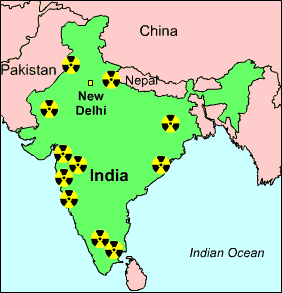
A map of India's nuclear facilities. See here for what they are and what they do.

Comments

Popular posts from this blog

Activists' Claims Distort Facts about Advanced Reactor Design

Below is from our rapid response team . Yesterday, regional anti-nuclear organizations asked federal nuclear energy regulators to launch an investigation into what it claims are “newly identified flaws” in Westinghouse’s advanced reactor design, the AP1000. During a teleconference releasing a report on the subject, participants urged the Nuclear Regulatory Commission to suspend license reviews of proposed AP1000 reactors. In its news release, even the groups making these allegations provide conflicting information on its findings. In one instance, the groups cite “dozens of corrosion holes” at reactor vessels and in another says that eight holes have been documented. In all cases, there is another containment mechanism that would provide a barrier to radiation release. Below, we examine why these claims are unwarranted and why the AP1000 design certification process should continue as designated by the NRC. Myth: In the AP1000 reactor design, the gap between the shield bu...

How many nuclear plants does it take to meet the world's energy needs?

Several weeks ago Joshua Pearce at Clarion University in Pennsylvania released a study titled “ Thermodynamic limitations to nuclear energy deployment as a greenhouse gas mitigation technology .” In the study he stated... nuclear energy production would have to increase by 10.5% per year from 2010 to 2050 to both replace fossil-fuel-energy use and meet the future energy demands. This line, of course, made the headlines and has been picked up by several outlets and blogs . When looking into his calculations for this statement, he made one assumption error that overstated the above sentence by nearly a factor of three. Page 121, Section 4.1 of the study states: Richard Smalley pointed out that in 2004, the global economy consumed the equivalent of 220 million barrels of oil per day, which converted into electricity terms is the equivalent of 14.5 TeraWatts (TW), or 14,500,000 MegaWatts (MW) (2005). … With a nuclear plant having about 1000 MW (1 GW) of capacity, we would need 14,500...

What Happens During a Refueling Outage?

You may have noticed over the past few weeks that a number of nuclear plants are shut down for refueling outages or are resuming operations after just returning from one. This type of routine outage usually occurs in the spring or fall when electricity demand is low so that nuclear reactors can replace about one-third of the spent fuel rods with new fuel and conduct other routine maintenance and repairs at the plant. To get a better sense of how refueling works at a nuclear energy facility, I spoke with Marcus Nichol, NEI’s senior project manager for used fuel storage and transportation, and asked him to explain the basics. Why does a nuclear plant need to replace one-third of its fuel? Nichol: The main purpose of a refueling outage is to replace older fuel that is depleted—meaning it can no longer efficiently produce energy from nuclear fission reactions—with new fuel. This “used fuel” has typically been used in the reactor for four-and-a-half to six years before it is pe...