Your Next Nuclear Vacation

610x The best takedown of the Swiss we know - because why would anyone want to take down the Swiss, after all? - comes from Orson Welles in The Third Man:

Don't be so gloomy. After all, it's not that awful. Like the fella says, in Italy for 30 years under the Borgias they had warfare, terror, murder, and bloodshed, but they produced Michelangelo, Leonardo da Vinci, and the Renaissance. In Switzerland, they had brotherly love - they had 500 years of democracy and peace, and what did that produce? The cuckoo clock.

Cuckoo clocks and now a way to recycle remnants of the cold war into something unique and just a little bizarre. Here's the complete writeup from World Nuclear News, which they took from Der Spiegel.

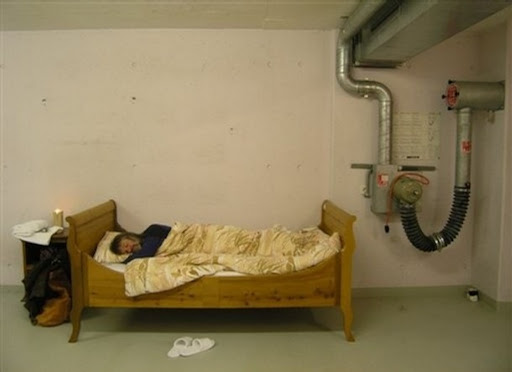
The world's first "zero-rated" hotel - a former underground nuclear bunker - is set to open in Sevelen, Switzerland. The abandoned bunker has been transformed into a budget hotel by twin brothers Patrik and Frank Riklin with the motto "less is more": it has not been painted, the beds are from a nearby condemned hospital and hot water is not guaranteed - but what would you expect for just $9 to $13 per night?

Patrik insists that the hotel's stark Cold War atmosphere is "damned comfortable." A monitor within the bunker gives guests in the windowless hotel their only view of the outside world.

One condition from the Swiss military is that the bunker be ready at all times to revert back to its original function within 24 hours.

A group of guests gave the 54-bedded hotel a trial run last week. The hotel can only start commercial operation if given approval by the town in November. However, the Riklin brothers are already setting their sights on setting up a chain of such hotels. "People could hike from bunker to bunker," Patrick said. "Bunkers will definitely go down well with Japanese tour groups," he added.

Clearly a good locale for your next horror film featuring a twitchy desk clerk who hasn't left the bunker in 40 years and the mewling protoplasmic ick in room 666 that he calls Mother.

To quote a minor character in the Third Man who struggles with his English, "He is now [points up] in hell, or [points down] in heaven."

Sounds like heaven.

Picture of the bunker hotel form the AP. Well, at least the room - er, space - looks big, not that common in Europe.

While Graham Greene wrote the screenplay for The Third Man, it's been acknowledged that Orson Welles wrote the Cuckoo Clock speech himself - remember, though, that Welles is playing the villain, Harry Lime, so we may assume he meant the speech to be Lime's cheerful cynicism, not a reflection of Welles' own feelings.

Comments

Brian Mays said…
Actually, it sounds downright cozy after some of the places that I've stayed in Europe.

Popular posts from this blog

Activists' Claims Distort Facts about Advanced Reactor Design

Below is from our rapid response team . Yesterday, regional anti-nuclear organizations asked federal nuclear energy regulators to launch an investigation into what it claims are “newly identified flaws” in Westinghouse’s advanced reactor design, the AP1000. During a teleconference releasing a report on the subject, participants urged the Nuclear Regulatory Commission to suspend license reviews of proposed AP1000 reactors. In its news release, even the groups making these allegations provide conflicting information on its findings. In one instance, the groups cite “dozens of corrosion holes” at reactor vessels and in another says that eight holes have been documented. In all cases, there is another containment mechanism that would provide a barrier to radiation release. Below, we examine why these claims are unwarranted and why the AP1000 design certification process should continue as designated by the NRC. Myth: In the AP1000 reactor design, the gap between the shield bu...

How many nuclear plants does it take to meet the world's energy needs?

Several weeks ago Joshua Pearce at Clarion University in Pennsylvania released a study titled “ Thermodynamic limitations to nuclear energy deployment as a greenhouse gas mitigation technology .” In the study he stated... nuclear energy production would have to increase by 10.5% per year from 2010 to 2050 to both replace fossil-fuel-energy use and meet the future energy demands. This line, of course, made the headlines and has been picked up by several outlets and blogs . When looking into his calculations for this statement, he made one assumption error that overstated the above sentence by nearly a factor of three. Page 121, Section 4.1 of the study states: Richard Smalley pointed out that in 2004, the global economy consumed the equivalent of 220 million barrels of oil per day, which converted into electricity terms is the equivalent of 14.5 TeraWatts (TW), or 14,500,000 MegaWatts (MW) (2005). … With a nuclear plant having about 1000 MW (1 GW) of capacity, we would need 14,500...

What Happens During a Refueling Outage?

You may have noticed over the past few weeks that a number of nuclear plants are shut down for refueling outages or are resuming operations after just returning from one. This type of routine outage usually occurs in the spring or fall when electricity demand is low so that nuclear reactors can replace about one-third of the spent fuel rods with new fuel and conduct other routine maintenance and repairs at the plant. To get a better sense of how refueling works at a nuclear energy facility, I spoke with Marcus Nichol, NEI’s senior project manager for used fuel storage and transportation, and asked him to explain the basics. Why does a nuclear plant need to replace one-third of its fuel? Nichol: The main purpose of a refueling outage is to replace older fuel that is depleted—meaning it can no longer efficiently produce energy from nuclear fission reactions—with new fuel. This “used fuel” has typically been used in the reactor for four-and-a-half to six years before it is pe...