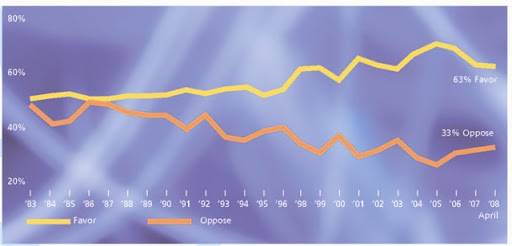
 We sometimes say here that the viability of nuclear energy from a public opinion perspective is ever improving. The reason we say that is that we look at polls that tell us so.
Now, NEI-sponsored polls, although they're as honestly conducted as can be - NEI really can't learn anything about its effectiveness by playing tricks - can still be viewed by some with a fishy eye. Any poll taken by an interested party on any subject can be seen as suspect - we've all seen polls that do not seem to correlate to any known reality. (Which doesn't mean we won't encourage you to take a look at NEI's public opinion efforts -er, click here, in other words.)
But here are numbers from rather more disinterested parties that show the how our fellow citizens view the state of building new nuclear energy plants:
53 percent said that we should build more nuclear power plants; 31 percent said we should not (NBC News/Wall Street Journal August 2008).
51 percent favored building more nuclear power plants as a way to reduce the country’s dependence on foreign oil; 41 percent opposed (Fox News/Opinion Dynamics June 2008).
67 percent supported building more nuclear power plants in the U.S.; 23 percent opposed (Zogby May 2008).
53 percent said they would support the construction of new nuclear power plants to meet future electric power needs; 36 percent opposed (Deloitte/ICR 2008).
57 percent supported building new nuclear power plants to generate electricity, knowing that “nuclear power is one of the energy sources, like wind and solar energy, that doesn’t contribute to global warming;” 34 percent opposed (Moore Information April 2008).
59 percent agreed that we should definitely build more nuclear power plants in the future; 39 percent disagreed (Bisconti Research for NEI April 2008.)
Okay, that last one was us. But before you crack wise and say, "A lot of hovering around 50% there," well, our presidential candidates should be so lucky. And even where the numbers hover around 50%, the undecided crowd number around 10-15% - numbers from which to grow. (That's how it works for the presidential candidates, too, come to think of it.)
As you can see, Zogby seems to be the outlier on the high side - all these firms have different methods and of course they all call different people. Number of respondents and margin of error play parts, too. We're pretty sure a combination of the black arts and pixie dust get involved with polling.
But the bottom line is that half or more Americans favor building nuclear energy plants and the numbers gets closer to 60 or higher when its "green" profile is made a part of the question. We could argue a lot about the objective value of "greeniness" - many do - but not its place in the popular consciousness. That matters, but not even as much as one might figure - its the very idea of nuclear energy that is finding more favor, and that matters a lot.
Chart from Perspectives on Public Opinion - POPO in NEI-speak. Clearer version can be found in the June 2008 issue linked above.
Comments
It's funny that you should mention the black arts. It wasn't too long ago that Gallup reported that "one in five Americans (21%) say they believe in witches" so it's not surprising that at least 20% of the general American population would buy into the nonsense being pushed by the likes of the Nuclear (Dis)information Resource Service.
Fortunately, common sense almost always wins out in the end for the majority of the population, so anything above 50% is pretty good, in my opinion.
In fairly short order it became the only kind being purchased.
Of course at the time the "industry" actively supported and explained its advantages, vs. today's timid squeeks from under their desks.