 FOX News, on this evening’s Special Report with Brit Hume, is expected to examine the security of America’s commercial nuclear power plants. Marvin Fertel, NEI’s executive vice president and chief nuclear officer, is one of the experts on security who discussed security with FOX News correspondent Julie Banderas.
Security in our post 9-11 world is an issue that can be used to unnecessarily alarm citizens if the complete—and complex—picture is not assessed. Some critics of the nuclear industry contend that not enough has been done to enhance security as nuclear power plants. Some even claim that Khalid Sheik Muhammad said that nuclear plants were one of the possible targets on 9/11.
In reality, terrorists often mention nuclear plants, chemical facilities, agriculture and government buildings because it is their purpose to scare people. But terrorists usually will avoid a hard target like a nuclear plant.
However, 7 out of 10 people believe that U.S. nuclear power plants are safe and secure, according to an April nationwide survey. Judge for yourself.
Since 9/11, the industry has invested more than $2 billion in additional security at 65 nuclear plant sites and has increased the number of specially trained, well-armed security forces by more than 60 percent.
Compared to other commercial facilities, nuclear power plants start with a clear advantage in the area of security. The structures that house reactors and critical systems are built to withstand natural events such as earthquakes, hurricanes, tornadoes, fires and floods.
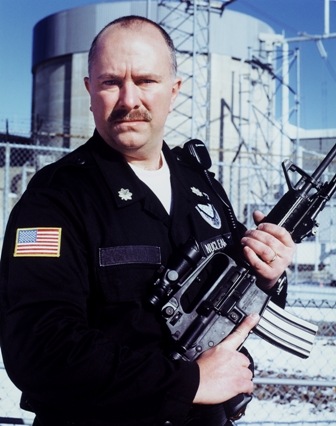
The difficult-to-penetrate structures are just the first level of a multistage, integrated security strategy. Nuclear power plant security is designed with concentric perimeters with increased security at each level. Physical barriers protect against unauthorized personnel and vehicle intrusion, including truck bombs. These security zones are protected by trained and armed professionals, who use hardened defensive fighting positions located throughout the plant, if needed.
In the innermost security zone, access to the vital areas of our plants is strictly controlled using biometrics and other technologies. Critical areas are under constant surveillance and monitored using state-of-the-art detection equipment.
In addition, every plant must conduct drills and exercises to ensure a well-prepared, comprehensive emergency response plan. Every site tests its security forces against federal security standards and the Nuclear Regulatory Commission inspects industry security against these standards in mandated “force-on-force” exercises. No other sector of the civilian-operated critical infrastructure has such a robust security program. In 2007, the industry completed the first three-year cycle of NRC-evaluated “force-on-force” security exercises – at every plant. No security forces in any private industry that are subjected to such rigorous testing that includes such drills using a full-time dedicated “assault” team.
The industry expects to be successful against most credible threats, even at levels greater than federal security requirements. But at some point, such threats require a more integrated response. Since 2001, the industry and federal agencies have recognized the importance of coordinating federal, state and local authorities with the industry to best defend against such an attack.
Given these steps, it is highly unlikely that attackers could successfully breach security at a nuclear power plant and even more unlikely they could produce a release of radiation that would endanger the residents near the plant.
Posted by Scott Peterson
Comments
"Some even claim" this? These "some" include the federal government's 9/11 commission in their final report.
http://www.9-11commission.gov/report/911Report.pdf (p. 154, PDF page 171)
I'm not taking issue with your broader points on NPP security. But you do your position and the industry a disservice when you appear to challenge a well-established point like this.
Lets see, Republicans want more nukes, FOX is pro-republican (as some insist). Sounds like FOX is having an ID-10T error.
Know Nukes
You do your anonymous colleagues a disservice when you appear to play the opposite side of this torture /spying on US citizens / FISA / terrorist surveillance issue... I guess well-established is in the eyes of the discreditor.
Some still claim that the WTC was taken down by government-planted explosives... even Rosie says fire can't melt steel, so apparently there's no scientific consensus there either...