This week at MSNBC, the online news service is running a five-part series on the renaissance of nuclear energy in the U.S. To say the least, I don't have many high hopes for it, as the author is Mike Stuckey, the same reporter who penned an anti-NEI hit job a number of months ago.
Still, the series is running and its important for our readers to know about it, even if it spends most of its length today talking over the politics of the issue. That's a shame, as there are serious reasons why nuclear energy is getting a second look, including the economic, energy security and national security implications of an industry expansion.
Stuckey is sure to go after the old saw about subsidies, but as David Bradish pointed out a few weeks ago, there's less there than anti-nukes would have you think. At a minimum, Stuckey's report should have mentioned that EPACT 2005 included subsidies and incentives for all sorts of sources of generation, including renewables. But you'd never know that from reading his piece.
Some folks are already picking up on the holes in the story, like the blog, Chaos-In-Motion:
Finally, they're also running an online poll asking: Does the U.S. nuclear power industry's safety record of the past 25 years warrant a "renaissance" of new reactors?.
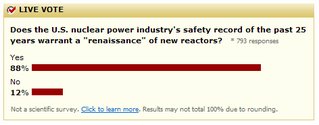 As you can see, the industry is doing pretty well. Be sure to stop by and make sure your voice is heard too. More later, as events warrant, all week long.
Technorati tags: Nuclear Power, Nuclear Energy, Environment , Energy, Politics, Technology, Economics, Electricity
Still, the series is running and its important for our readers to know about it, even if it spends most of its length today talking over the politics of the issue. That's a shame, as there are serious reasons why nuclear energy is getting a second look, including the economic, energy security and national security implications of an industry expansion.
Stuckey is sure to go after the old saw about subsidies, but as David Bradish pointed out a few weeks ago, there's less there than anti-nukes would have you think. At a minimum, Stuckey's report should have mentioned that EPACT 2005 included subsidies and incentives for all sorts of sources of generation, including renewables. But you'd never know that from reading his piece.
Some folks are already picking up on the holes in the story, like the blog, Chaos-In-Motion:
Greenpeace, the foe of anything human is not who I would have gone to for a comment. What alternative technology which is capable of running our industries, does Greenpeace support? I'm betting none. Solar and wind won't do it, and I'm betting they'd stand against any scaling of that technology to the level that would support the present economy.For more from another perspective, click here.
They of course have the usual litany of statements about Chernobyl and TMI. No real discussion of scope or similarity of the plants or the problems and the related solutions. Just that the industry has improved its safety procedures. Then for some reason the article goes into a long tirade on the Cheney Energy commission. Sadly the article spends most of its time wandering around the politics or the issue rather than the viability or comparative use in a world with a strong need to move away from fossil fuels.
Finally, they're also running an online poll asking: Does the U.S. nuclear power industry's safety record of the past 25 years warrant a "renaissance" of new reactors?.
 As you can see, the industry is doing pretty well. Be sure to stop by and make sure your voice is heard too. More later, as events warrant, all week long.
Technorati tags: Nuclear Power, Nuclear Energy, Environment , Energy, Politics, Technology, Economics, Electricity
Comments
I learned some stuff. If you think you're a know-it-all-nuke, then check it out. (Guilty: I do have a twisted idea of fun.)
http://www.msnbc.msn.com/id/16692861/